




— Blogs —
—Products—
 Consumer hotline +8618073152920
WhatsApp:+8615367865107
Address:Room 102, District D, Houhu Industrial Park, Yuelu District, Changsha City, Hunan Province, China
Product knowledge
Time:2024-08-11 14:55:10 Popularity:2398
The price of a soil EC sensor depends on its measurement parameters, electrical conductivity range, accuracy, output interface, probe construction, cable length and order quantity. A soil electrical conductivity sensor used for basic agricultural monitoring may have different requirements from an integrated soil temperature, moisture, EC and salinity monitoring system.
For professional agricultural and environmental monitoring, NiuBoL offers soil EC measurement through integrated probes such as the NBL-S-TMC 3-in-1 Soil Sensor and NBL-S-TMCS 4-in-1 Soil Sensor. Both provide RS485 Modbus RTU communication for connection to compatible PLCs, data loggers and IoT gateways.
To compare soil EC sensor costs accurately, consider the complete measurement configuration rather than only the advertised unit price. Installation accessories, data acquisition equipment, communication requirements and shipping may also affect the total project cost.

Soil EC sensor pricing varies according to the sensor design and the supplied configuration. An individual probe price should not be confused with the cost of a complete soil monitoring station that includes a data logger, power supply, communication equipment and software integration.
For NiuBoL soil EC sensors, quotation requirements typically include the selected model, measurement range, RS485 communication, cable length, quantity and destination country.
| Purchase Scope | Cost Considerations |
| Sensor Only | Probe model, measurement parameters, cable length and quantity |
| Sensor + Data Logger | Sensor price plus compatible RS485 acquisition equipment |
| Remote Soil Monitoring Station | Sensors, data logger, gateway, communication, enclosure and power supply |
| Multi-Point Agricultural Project | Number of locations, depth configuration, cabling, installation and system integration |
For an accurate quotation, specify whether the requirement is for a standalone sensor or a complete monitoring system. Project-specific prices can then be compared on an equivalent technical and commercial basis.
Several technical and commercial factors influence soil conductivity sensor costs. The following items are particularly relevant when comparing quotations for agricultural, greenhouse and environmental monitoring projects.
| Factor | Influence on Product Selection and Cost |
| Measured Parameters | A sensor measuring EC, moisture and temperature has a different functional scope from one that additionally provides salinity |
| Measurement Range | The expected conductivity must remain within the selected model's specified range |
| Accuracy and Calibration | Measurement performance, calibration requirements and supporting documentation affect instrument selection |
| Output Interface | RS485 Modbus compatibility determines which data logger, PLC or gateway can be used |
| Probe and Cable | Cable length, connectors, sealing and the mechanical installation arrangement affect the supplied configuration |
| Order Quantity | Sample orders and larger project quantities may have different commercial terms |
| Shipping and Accessories | Delivery destination, cable protection, mounting accessories and additional equipment affect total landed cost |
NiuBoL provides integrated soil sensors that measure electrical conductivity together with other soil parameters. Selecting a multi-parameter sensor can reduce the number of separate probes required at each monitoring point.
The NBL-S-TMC Soil Sensor combines soil temperature, volumetric moisture and electrical conductivity measurements in one probe. It uses FDR technology for moisture measurement and an AC bridge method for conductivity measurement.
The sensor provides RS485 Modbus RTU communication, making it suitable for continuous soil monitoring systems connected to PLCs, data loggers, irrigation controllers and IoT gateways.

The NBL-S-TMCS Soil Sensor measures soil temperature, moisture, EC and salinity using one integrated sensing probe.
This configuration is suitable for projects where both conductivity and a model-derived salinity indication are required alongside temperature and moisture monitoring.
A four-parameter sensor may reduce the need for separate instruments, but the complete project cost still depends on the monitoring-point quantity, data acquisition equipment and installation arrangement.
The following specifications apply to the referenced NiuBoL NBL-S-TMC and NBL-S-TMCS models. They should not be treated as universal specifications for every soil conductivity sensor.
| Specification | NBL-S-TMC | NBL-S-TMCS |
| Measurements | Temperature, Moisture, EC | Temperature, Moisture, EC, Salinity |
| EC Range | 0–10000 µS/cm | 0–10000 µS/cm |
| EC Resolution | 1 µS/cm | 1 µS/cm |
| Specified EC Accuracy | ±5% | ±5% |
| Salinity Output | No separate channel | 0–8000 mg/L |
| EC Method | AC Bridge | AC Bridge |
| Output | RS485 Modbus RTU | RS485 Modbus RTU |
| Standard Cable | 5 m | 5 m |
For the referenced configurations, the conductivity temperature-compensation range is specified as 0–50°C. Confirm the required supply voltage and cable configuration when ordering.
Electrical conductivity describes how readily electrical current passes through a measured medium. In soil, conductivity is influenced by dissolved ions, water content, temperature, soil structure and the electrical contact between the probe and the surrounding soil.
Soil EC can help monitor changes in root-zone salinity conditions, irrigation-water effects and fertilizer-related conductivity trends. However, soil EC is not a direct measurement of individual nutrient concentrations.
An EC value alone cannot determine the concentrations of nitrogen, phosphorus, potassium or particular dissolved salts because different ions contribute to the overall conductivity.
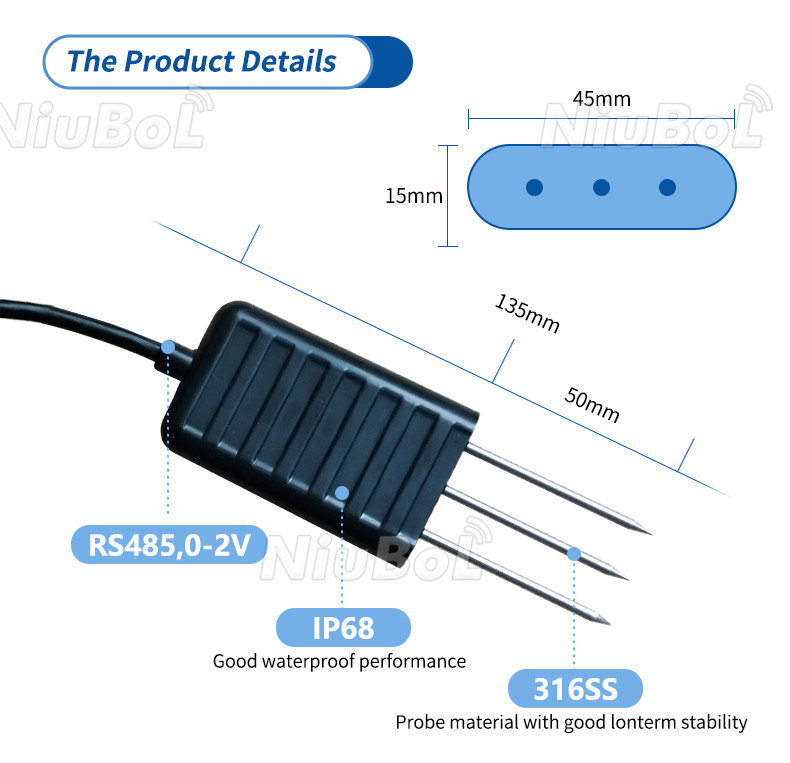
Soil conductivity measurements may be obtained using different methods, including in-situ soil probes, soil solution measurements and laboratory soil extracts.
These methods have different measurement conditions and are not automatically interchangeable. A field EC reading from an inserted probe should not be treated as identical to the electrical conductivity of a laboratory saturated-paste extract (ECe).
For projects requiring laboratory-defined soil salinity classifications or chemical analysis, use the corresponding reference method and interpretation procedure.
When comparing soil EC data between fields, depths or monitoring periods, measurement conditions should remain as consistent as practical.
| Factor | Measurement Consideration |
| Soil Moisture | Water content affects conductive pathways and the relationship between dissolved ions and measured EC |
| Temperature | Electrical conductivity varies with temperature; suitable compensation improves comparability |
| Soil Texture | Sand, loam, clay and substrates have different physical and electrical characteristics |
| Fertilizer Application | Additional dissolved ions may change soil conductivity |
| Probe Contact | Air gaps and poor electrode contact may affect measurement consistency |
| Installation Depth | Soil conductivity can differ between root-zone layers |
For spot measurements, select a representative soil location and avoid stones, large roots and other hard objects. Insert the electrodes fully into the soil according to the probe design, and avoid rocking the instrument from side to side.
For long-term monitoring, install the probe at the required depth with firm contact between the electrodes and undisturbed soil. Protect cables and connectors from water ingress, mechanical damage and field operations.
Because soil moisture affects EC measurements, comparisons made under similar moisture conditions are generally more useful for identifying longer-term conductivity trends.
Soil electrical conductivity monitoring is used in agriculture and environmental applications where changes in soluble salts and root-zone conditions are important.
Precision Agriculture • Irrigation Monitoring • Greenhouses
Orchards • Salinity Monitoring • Fertigation
Soil Research • Horticulture • Environmental Monitoring

Soil EC measurements can be combined with moisture, temperature, irrigation and rainfall records to provide more useful information than an isolated conductivity reading.
An RS485 soil EC sensor provides digital measurement data to compatible PLCs, RTUs, agricultural data loggers and IoT gateways. The data acquisition system can record multiple sensors and organize measurements by field, monitoring point and depth.
Soil EC Sensor → RS485 Modbus RTU → Data Logger / PLC → 4G / Ethernet / Supported Network → Cloud or Private Server
RS485 is a local communication interface. Remote 4G transmission, MQTT communication, historical storage and cloud integration require compatible data acquisition or gateway equipment.
For projects using several sensors on one RS485 network, confirm unique Modbus addresses, power-supply capacity, cable routing and communication settings.
A technically comparable quotation should identify exactly what is included in the supply. Two offers with different sensing parameters, output versions or accessories may not represent equivalent products.
| Quotation Item | Information to Confirm |
| Model | NBL-S-TMC, NBL-S-TMCS or other required configuration |
| Parameters | EC only or EC combined with temperature, moisture and salinity |
| Measurement Requirements | EC range, specified accuracy and monitoring conditions |
| Electrical Configuration | RS485 Modbus version and required DC supply |
| Accessories | Cable length, connectors, logger, enclosure and power supply |
| Commercial Scope | Quantity, delivery location, shipping cost, lead time and warranty terms |

A1. The cost depends on the measurement parameters, EC range, accuracy, communication interface, construction, cable length, order quantity and accessories included.
A2. The 3-in-1 and 4-in-1 models have different measurement functions, but their actual selling prices depend on the quoted configuration, quantity and commercial terms. Compare both quotations for the same installation and delivery requirements.
A3. The published soil EC range is 0–10000 µS/cm, with 1 µS/cm resolution and specified ±5% accuracy within that range.
A4. Yes. The NBL-S-TMC and NBL-S-TMCS provide RS485 Modbus RTU communication for connection to compatible data loggers, PLCs and gateways.
A5. No. EC measures overall electrical conductivity resulting from dissolved ions. Individual nutrient concentrations cannot be determined reliably from EC alone and require appropriate nutrient-specific or laboratory methods.
A6. Selected sealed probes are designed for long-term soil installation. Reliable operation requires correct burial, suitable probe contact, cable protection and routine monitoring-system inspection.
A7. The RS485 sensor provides local measurement data. Remote transmission to a cloud platform or private server requires a compatible data logger or IoT gateway with the required network connection.
A8. Provide the required measurement parameters, soil conditions, EC range, quantity, installation depth, cable length, power supply, communication requirements and shipping destination.
The following technical documents provide model-specific information on measurement parameters, installation and RS485 communication.
 NBL-S-TMC Soil Temperature, Moisture and EC Sensor Manual
NBL-S-TMCS Soil Temperature, Moisture, EC and Salinity Sensor Manual
NiuBoL supplies RS485 soil electrical conductivity sensors for irrigation, greenhouses, orchards, salinity monitoring, agricultural research and multi-point soil monitoring projects.
For product selection and quotation, provide the sensor model or required parameters, EC measurement range, soil type, installation depth, cable length, power supply, quantity, delivery country and data logger or gateway requirements.
Explore the NiuBoL Soil Electrical Conductivity Sensors overview, or review the NBL-S-TMC 3-in-1 Soil EC Sensor and NBL-S-TMCS 4-in-1 Soil Sensor product pages for technical selection.
Related recommendations
Sensors & Weather Stations Catalog
 Agriculture Sensors and Weather Stations Catalog-NiuBoL.pdf
Weather Stations Catalog-NiuBoL.pdf
Agriculture Sensors Catalog-NiuBoL.pdf
Water Quality Sensor Catalog-NiuBoL.pdf
Related products
 Combined air temperature and relative humidity sensor
 TDR Soil Moisture & Temperature Sensor for irrigation| RS485 |4-20mA| NBL-S-THR
 Soil pH sensor RS485 soil Testing instrument soil ph meter for agriculture |NBL-S-PH
 Wind Speed sensor Output Modbus/RS485/Analog/0-5V/4-20mA
 Tipping bucket rain gauge for weather monitoring auto rainfall sensor RS485/Outdoor/stainless steel
 Pyranometer Solar Radiation Sensor 4-20mA/RS485


Screenshot, WhatsApp to identify the QR code
WhatsApp number:+8615367865107
(Click on WhatsApp to copy and add friends)

