




— Blogs —
—Products—
 Consumer hotline +8618073152920
 WhatsApp:+8615367865107
Address:Room 102, District D, Houhu Industrial Park, Yuelu District, Changsha City, Hunan Province, China
Product knowledge
Time:2023-10-15 16:34:48 Popularity:1607
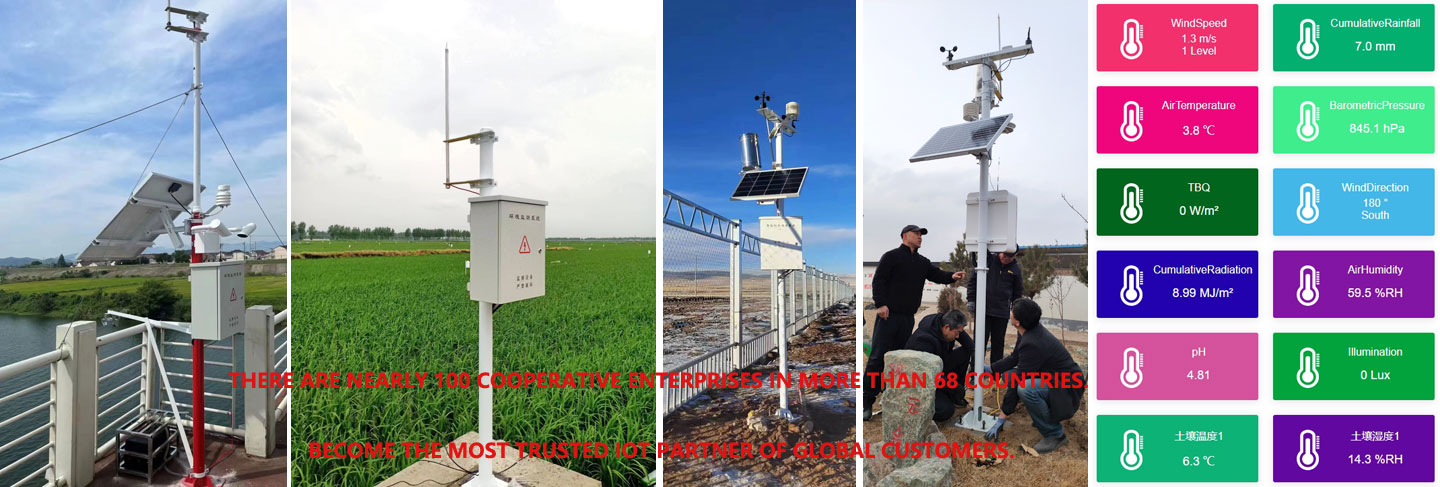
Solar radiation sensor application scenarios include weather stations, PV power plants, agriculture, solar resource studies and environmental monitoring. The useful selection step is to match the scenario to radiation component, output and installation method.
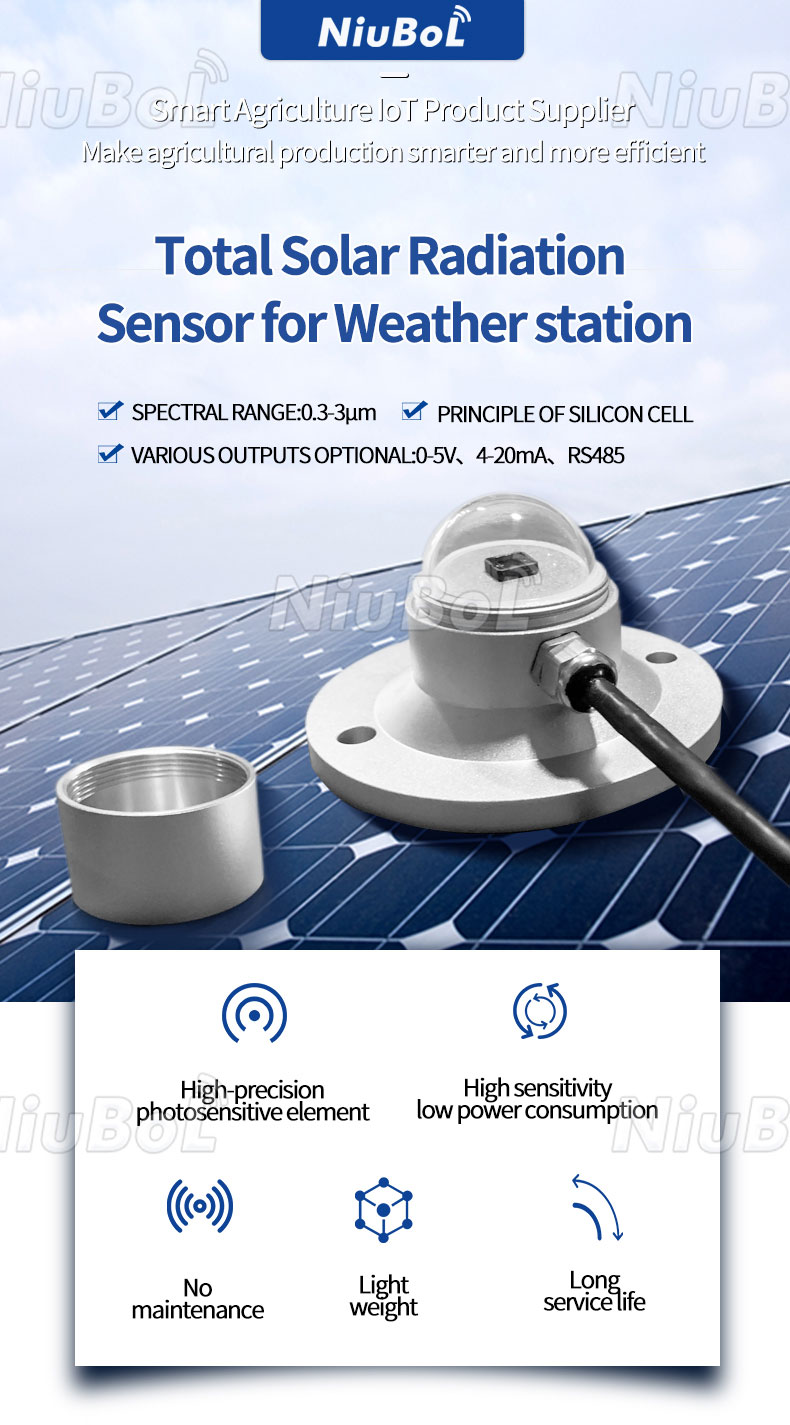
PV projects use radiation data to compare sunlight resource with plant output. The buyer should define whether the sensor is horizontal or mounted in the module plane, and whether the monitoring platform reads RS485, analog or millivolt data.
Agricultural and weather projects use radiation data for crop light condition, evaporation reference and climate records. Open sky view and cleaning are more important than adding unrelated station parameters.
| Item | NiuBoL solar radiation reference |
|---|---|
| NBL-W-HPRS range | 0-2000 W/m2 |
| NBL-W-HPRS spectral range | 0.3-3 μm |
| NBL-W-HPRS-A range | 0-4000 W/m2 |
| NBL-W-HPRS-A spectral range | 280-3000 nm at 50% transmittance |
| Output | Millivolt, voltage, 4-20 mA or RS485 depending on model |
| Protocol | Modbus RTU for RS485 versions |
| Installation | Level, unshaded exposure |

Check measured range, spectral range, mounting plane, cable route, logger input and maintenance access. For remote sites, confirm power and communication together with the station host.

A solar radiation sensor is suitable when the measurement surface can remain level, clean and free from shade. It is less suitable when the only available location is under a tower, near moving machinery or beside tall seasonal crops that will shade the sensor later. The buyer should review the physical site, not only the parameter list.
In PV plants, the sensor helps compare irradiance with power output. In agricultural monitoring, it supports crop environment evaluation. In meteorological stations, it becomes part of the weather record. These scenarios use the same basic parameter but require different acceptance details. A PV project may care about alignment with production records, while an agricultural project may care about integration with soil moisture and irrigation timing.
RS485/Modbus RTU is usually preferred when the sensor is part of a station bus or an industrial data logger. Analog output can be appropriate for legacy acquisition systems. Millivolt output requires a compatible high-resolution input and more careful wiring practice. Selecting the signal type before installation prevents unnecessary converters in the cabinet.
Most weather and agricultural projects can be evaluated against the standard radiation range required by the selected NiuBoL model. High-radiation or special research applications should confirm whether the 0-4000 W/m2 reference range of the NBL-W-HPRS-A is relevant. The buyer should not choose a wider range by default; the receiving system, resolution and purpose should all be considered together.
For Solar Radiation Sensor Application Scenarios, confirm the application, measured parameter, output type, installation position and receiving system before comparing products or quotations. This keeps the article topic tied to a real project decision.
For solar radiation sensor application scenarios, record address, baud rate, register map, unit and polling interval. Keep this with the logger configuration for future maintenance.
For solar radiation sensor application scenarios, send application, required radiation channel, mounting surface, power supply, output signal, cable length and the device that will receive the data.
For solar radiation sensor application scenarios, radiation data can mislead when the sensor is shaded by the station mast, solar panel, nearby building or seasonal vegetation.
For solar radiation sensor application scenarios, acceptance should show stable live reading, correct unit, timestamp, stored data path and safe access to inspect or clean the sensing surface.
For solar radiation sensor application scenarios, confirm global radiation, diffuse radiation, direct radiation or an irradiance display requirement. These are not always the same measuring task.
Solar radiation sensor scenarios should be specified by measured data and site conditions. NiuBoL options can be matched after range, output and installation are defined.
Prev:Application advantages of solar radiation sensors
Next:What are the applications of solar radiation sensors in meteorological observations?
Related recommendations
Sensors & Weather Stations Catalog
 Agriculture Sensors and Weather Stations Catalog-NiuBoL.pdf
Weather Stations Catalog-NiuBoL.pdf
Agriculture Sensors Catalog-NiuBoL.pdf
Water Quality Sensor Catalog-NiuBoL.pdf
Related products
 Combined air temperature and relative humidity sensor
 Soil Moisture Temperature sensor for irrigation|NBL-S-THR
 Soil pH sensor RS485 soil Testing instrument soil ph meter for agriculture |NBL-S-PH
 Wind Speed sensor Output Modbus/RS485/Analog/0-5V/4-20mA
 Tipping bucket rain gauge for weather monitoring auto rainfall sensor RS485/Outdoor/stainless steel
 Pyranometer Solar Radiation Sensor 4-20mA/RS485

Screenshot, WhatsApp to identify the QR code
WhatsApp number:+8615367865107
(Click on WhatsApp to copy and add friends)

